

In short
Commercial HVAC services maintain and repair the equipment that heats, cools and ventilates a commercial building, including air handling units, fan coil units, ventilation fans and the controls that run them. A good maintenance approach considers equipment condition, occupancy, operating schedules and the demand placed on each system.
What the work may involve
- Air handling units
- Fan coil units
- Heating and cooling systems
- Ventilation equipment
- HVAC fault diagnosis
- Planned HVAC maintenance
- Building controls integration
Warning signs to report
- Stuffy rooms or poor air movement
- Areas too hot or too cold compared with setpoints
- Noisy fans, belts or bearings
- Water leaks from fan coils or condensate drains
- Frequent HVAC alarms on the BMS
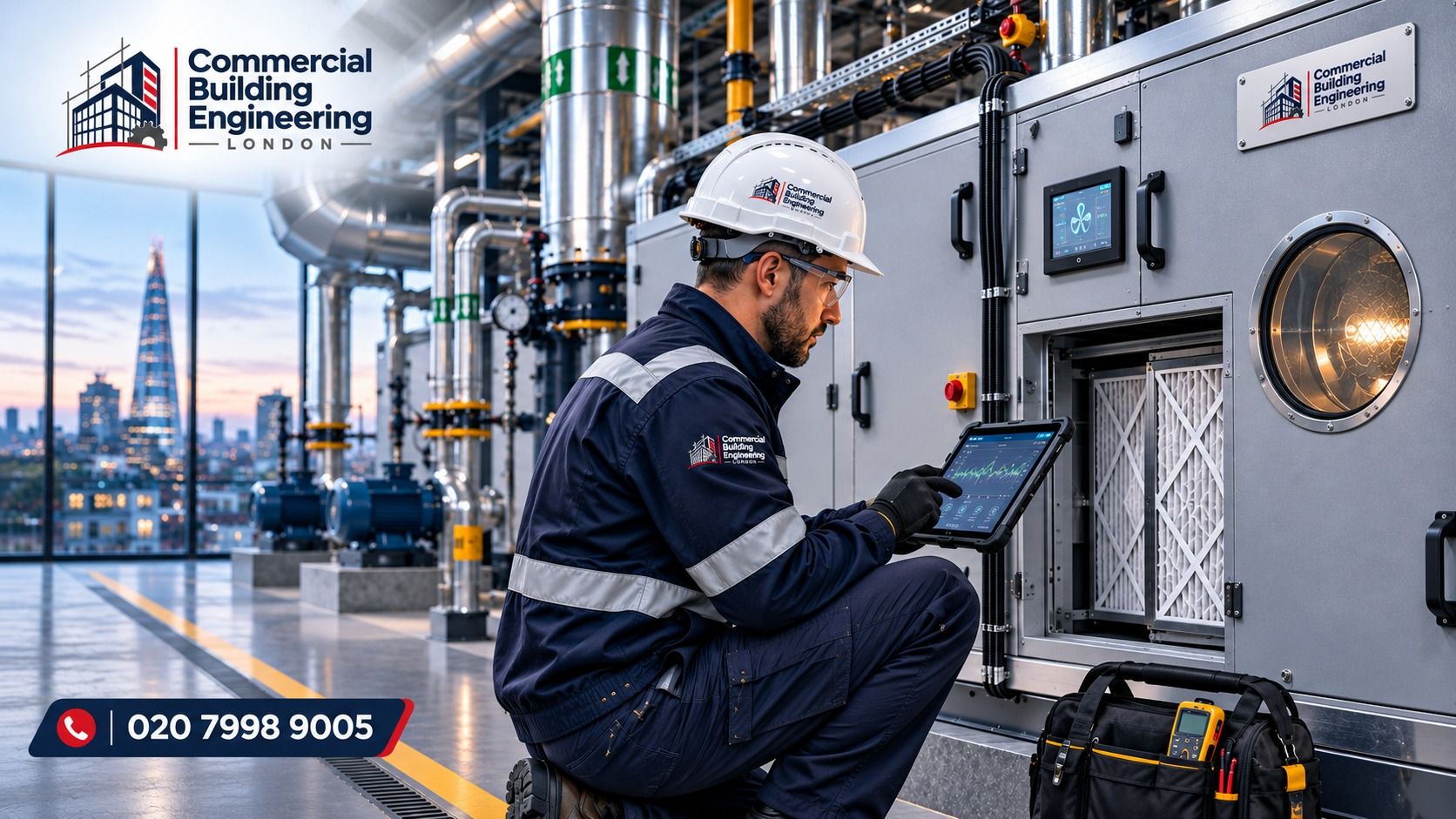
The equipment behind commercial HVAC
Commercial HVAC can include air handling units (AHUs) supplying treated air, fan coil units (FCUs) heating or cooling individual spaces, extract and supply fans, chillers and condensing units, and the controls that schedule and modulate it all. In many buildings these are connected to a BMS, so a single control fault can affect comfort across several floors.
Common HVAC faults
| Symptom | Possible areas to investigate |
|---|---|
| Poor ventilation or stuffiness | AHU fans, filters, dampers, BMS schedules |
| Hot or cold spots | Fan coil valves and actuators, sensors, setpoints |
| Noise and vibration | Fan bearings, belts, mountings, loose panels |
| Water leaks | Condensate drains and pumps, coil connections |
| High energy use | Schedules, simultaneous heating and cooling, controls |
These are possible causes rather than a diagnosis. An engineer needs to assess the actual equipment.
Planned HVAC maintenance
An effective programme is built around the equipment installed, how long it runs, how the building is occupied and any manufacturer guidance. Typical tasks include filter changes, belt and bearing checks, coil and drain cleaning, damper and actuator checks and control verification. See planned preventative maintenance.
Work on refrigerant circuits must be carried out by appropriately F gas certified engineers. Do not open or adjust refrigeration equipment.
HVAC and building controls
Because HVAC performance depends so heavily on controls, many problems are best investigated alongside the BMS. Checking schedules, sensor readings and valve positions against what the equipment is actually doing often shows the root cause faster.
Discuss your commercial hvac requirements
Send the equipment details, symptoms and site address through Flair Facilities Ltd, or call to talk it through.
Commercial HVAC FAQs
What is the difference between commercial HVAC and mechanical engineering?
HVAC focuses on heating, ventilation and air conditioning. Mechanical building engineering is broader and can also include boilers, water-pressure systems, pumps, pipework, plant rooms and associated infrastructure.
Why are some offices too warm while others are too cold?
Causes include fan coil faults, valve or actuator problems, incorrect setpoints, sensor errors, airflow restrictions and changes in how spaces are used. Controls and equipment should be checked together.
How often should air handling units be maintained?
Frequency depends on the unit, manufacturer guidance, operating hours and the environment. Filters, belts, fans, coils, drains and dampers usually need regular inspection as part of a planned programme.
Do you work on air-conditioning refrigerant circuits?
Work on refrigerant circuits must only be carried out by engineers holding the appropriate F gas certification. Building staff should not attempt to work on refrigerant systems.
Can HVAC problems increase energy use?
They can. Equipment running outside occupied hours, heating and cooling fighting each other, blocked filters and poorly tuned controls are common contributors. An assessment can identify which apply.
Useful UK references
- Ventilation in the workplace Health and Safety Executive
- F gas in refrigeration and air conditioning GOV.UK
- Workplace temperatures Health and Safety Executive
Last reviewed 20 November 2026. General guidance only; it does not replace a qualified site-specific assessment.